|
an archive of my forays into fact and fiction
|
|
Standish; Erastes
— Love @ 13:38 Comments (2)
Filed under: Back to History, D, English, GLBT interest, Historical, Romance
 Standish Standish
by Erastes

For the Back to History reading challenge.
English
215 pages
P.D. Publishing Inc.
ISBN: 1-933720-09-3
First line: The candle guttered, and Ambrose looked up at it with a frown, the long blond hair falling away from the sides of his face.
Back cover blurb:
A great house. A family dispossessed. A sensitive young man. A powerful landowner. An epic love that springs up between two men. Set in the post-Napoleonic years of the 1820’s, Standish is a tale of two men — one man discovering his sexuality and the other struggling to overcome his traumatic past.
Ambrose Standish, a studious and fragile young man, has dreams of regaining the great house his grandfather lost in a card game. When Rafe Goshawk returns from the continent to claim the estate, their meeting sets them on a path of desire and betrayal which threatens to tear both of their worlds apart.
Painting a picture of homosexuality in Georgian England, Standish is a love story of how the decisions of two men affect their journey through Europe and through life.
Thoughts: From the moment I came across this book on Amazon.co.uk, I knew I had to read it. The story sounded amazing and I just love historical gay romance, there’s no denying that. Unfortunately, I was in for quite a disappointment.
I started reading it in January, got about a third of the way through during my first sitting with it, and then I put it down and did not pick it up again until now. I kept trying to persuade myself that if I read only one chapter a day, I would finish it in less than a month, but there just was no way of doing it. I wanted so badly to love the story, and I just couldn’t do it. I had such a hard time with the language and the way it was written — they didn’t appeal to me at all.
Finally, I picked it up again and found that if I just skimmed certain bits, it was tolerable. And so I finished the remaining two-thirds in a second sitting. I even, towards the end, found myself almost enjoying it. A part of the reason for this was, I dare say, the character of Padraig Fleury who appeared in the second half of the novel.
In the end, I didn’t like it even half as much as I had hoped to going in, but on the other hand, I did like it more than I thought I would after the first third. Even though it’s nowhere near the best book I’ve ever read, I am glad I decided to stick with it and read the entire thing. I have rarely been so close to making a book a DNF (did not finish), though. If it weren’t for the fact that I had it on my (no changes allowed) list of books for the Back to History challenge, or the fact that I had paid money for it and didn’t much like the idea of that being wasted, I don’t think I would have finished.
However, apart from all that I have outlined above, there was another thing that particularly bothered me. At one point Ambrose reads Dracula. Which is, y’know, cool and all. Except Standish is set in 1821 and Dracula wasn’t published until 1897, so unless there was time travel that I completely missed, that’s a big mistake on the part of the author, and that loses them a lot of respect from me.
I should think it obvious that the rating is not going to be a great one, but in the end, solely thanks to Fleury, it does manage a D, rather than an F. I realise we are only at the end of February and that much of the reading year remains, but I will be much surprised if this does not end up being “Disappointment of the Year.â€
Duty and Desire; Pamela Aidan
— Love @ 14:34 Comments (5)
Filed under: A-Z Reading Challenge, C, English, Historical, Romance
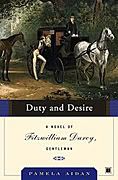 Duty and Desire Duty and Desire
by Pamela Aidan

For the A-Z reading challenge.
English
304 pages
Touchstone
ISBN: 978-0-7432-9136-1
First line: Darcy recited the collect for the first Sunday in Advent, his prayer book closed upon his thumb as he stood alone in his family’s pew at St. ——‘s.
Back cover blurb:
Jane Austen’s classic novel Pride and Prejudice is beloved by millions, but little is revealed in the book about the mysterious and handsome hero, Mr. Darcy. And so the question has long remained: Who is Fitzwilliam Darcy?
Pamela Aidan’s trilogy finally answers that long-standing question, creating a rich parallel story that follows Darcy as he meets and falls in love with Elizabeth Bennet. Duty and Desire, the second book in the trilogy, covers the “silent time” of Austen’s novel, revealing Darcy’s private struggle to overcome his attraction to Elizabeth while fulfilling his roles as landlord, master, brother, and friend.
When Darcy pays an old visit to an old classmate in Oxford in an attempt to shake Elizabeth from his mind, he is set upon by husband-hunting society ladies and ne’er-do-well friends from his university days, all with designs on him—some for good and some for ill. He and his sartorial genius of a valet, Fletcher, must match wits with them all, but especially with the curious Lady Sylvanie.
Thoughts: If you remember, I quite liked the first book in this series, which I read back in January. This continuation, however, I was not quite as fond of. Aidan’s Darcy, when completely away from Lizzy, is not as captivating as her version of Darcy when he has to struggle to keep his thoughts in check in her presence.
Fletcher, his valet, I do still quite like. He takes a few liberties and makes enough hints that I am pretty sure he knows where things are heading, even when Darcy does not. I even have a few suspicions as to the identity of his future wife’s current employer.
Even though I did not much like this book, I still intend to read the third, and final, installment of the trilogy. Lizzy is coming back for that, after all, and I am quite looking forward to how Aidan writes the disastrous first proposal and Darcy’s reactions to Lizzy in Derbyshire.
The first installment received a B grade and this one receives a C. I hope the next one manages at least a B, because I would be sad if it didn’t, when the first was so promising.
A Countess Below Stairs; Eva Ibbotson
— Love @ 18:23 Comments (5)
Filed under: A, A-Z Reading Challenge, Back to History, English, Historical, Romance
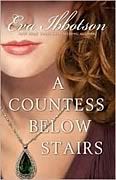 A Countess Below Stairs A Countess Below Stairs
by Eva Ibbotson
For the Back to History and A-Z reading challenges.
English
383 pages
Speak
ISBN: 978-0-14-240865-0
First line: In the fabled, glittering world that was St. Petersburg before the First World War there lived, in an ice-blue palace overlooking the river Neva, a family on whom the gods seemed to have lavished their gifts with an almost comical abundance.
Back cover blurb:
After the Russian Revolution turns her world topsy-turvy, Anna, a young Russian countess, has no choice but to flee to England. Penniless, Anna hides her aristocratic background and takes a job as a servant in the household of the esteemed Westerholme family, armed only with an outdated housekeeping manual and sheer determination.
Desperate to keep her past a secret, Anna is nearly over-whelmed by her new duties—not to mention her instant attraction to Rupert, the handsome Earl of Westerholme. To make matters worse, Rupert appears to be falling for her as well. As their attraction grows stronger, Anna finds it more and more difficult to keep her most dearly held secrets from unraveling. And then there’s the small matter of Rupert’s beautiful and nasty fiancée…
Thoughts: This is, without a doubt, one of my favourite books. I think it might even trump Pride and Prejudice as the one. I first read it in ninth grade when I found it, quite by accident, in the library at school. I was familiar with Ibbotson’s other body of work, those fantastical books of hers aimed at children, but I didn’t know she also wrote for another audience. At first, I admit I was a little doubtful—it was a romance, after all, and the translation was rather sloppily done (the original title was written as “A Countness Below Stairs”, that’s how sloppy it was), and the cover didn’t look like much. But oh god, I was blown away! I overlooked the typos and the printing errors, and just devoured the book. When I put it down, my eyes were wet from tears (I can be an übersap, sometimes) and it was late at night. The next day, when I came home from school, I picked it back up and read it all over again.
Since then, I’ve read it over and over again, always still in the same sloppy translation, but now I’ve finally found it in the original and thus it was almost like discovering it all over again. I can now tell that while the publishing work of the translation left quite a bit to be desired, the actual translation wasn’t half-bad. I know it so well now that reading the original, I was a little astounded that the errors I had grown so used to weren’t there. But oh, how I still love it! And still, this the sixth (or seventh? I’ve lost count) time I read it, I was still moved to tears in the exact same places, even though I know how it all ends.
As you know, I don’t usually post quotes, but sometimes I simply have to make an exception. Lord Peter Wimsey books often produce such exceptions, and so does A Countess Below Stairs.
“Rupert, none of your servants are socialists, I hope?”
“Good heavens no, I shouldn’t think so. I mean, I haven’t asked. Surely you don’t have to be a socialist to want to have a bath?”
“It often goes together,” said Muriel sagely.
And so they played some of the world’s loveliest piano music—the exiled homesick girl, the humiliated, tired old man. Not properly. Better than that.
Torn between despair and embarrassment, between loneliness and shame, the earl’s dog stood before them, his great head raking the room. He had done it, the unspeakable thing. The degradation, the horror of it, was behind him—and now where was she? Had it all been in vain; the debasement, the agony, the choice?
But no, it was all right. He’d seen her. She was there. She would make whole what was broken, console him for his master’s absence, would understand his imperative need to be scratched now, this minute, and for a long time in that special place behind his ear.
It’s seems a bit like stating the too obvious at this point, but the rating I’m giving this book is a solid A. There’s no other alternative — trust me on this. What’s a bit funny, though, is that I’m not head over heels for any of the characters, nor really the writing either, which is usually the case for me. I just completely and utterly love the whole book.
To end this post, I’m going to post the link to a music video on YouTube. The song is I Saved the World Today by The Eurythmics and no, there’s no apparent connection. But when I first read A Countess Below Stairs, the single had just been released and was being played on the radio as I read the book, and so the two will always, for me, be interconnected.
By a Lady; Amanda Elyot
— Love @ 23:40 Comments (1)
Filed under: Chick lit, English, F, Historical, Romance
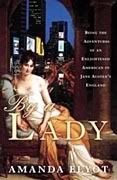 By a Lady By a Lady
by Amanda Elyot
English
372 pages
Three Rivers Press
ISBN: 1-4000-9799-1
First line: “It’s beautiful,” C.J. murmured, examining the curiously pockmarked amber cross.
Back cover blurb:
New York actress C.J. Welles, a die-hard Jane Austen fan, is on the verge of landing her dream role: portraying her idol in a Broadway play. But during her final audition, she is mysteriously transported back to Bath, England, in the year 1801. And Georgian England, with its rigid and unforgiving social structure and limited hygiene facilities, is not quite the picturesque costume drama C.J. had always imagined.
Just as she wishes she could click her heels together and return to Manhattan, C.J. meets the delightfully eccentric Lady Dalrymple, a widowed countess who takes C.J. into her home, introducing her as a poor relation to Georgian society—including the dashing Earl of Darlington and his cousin, Jane Austen!
When a crisis develops, C.J.—in a race against time—becomes torn between two centuries. An attempt to return to her own era might mean forfeiting her blossoming romance with the irresistible Darlington and her growing friendship with Jane Austen, but it’s a risk she must take. And in the midst of this remarkable series of events, C.J. discovers something even more startling—a secret from her own past that may explain how she wound up in Bath in the first place.
Thoughts: I read about this book on a blog a while back (I forget which one, I’m sorry to say) and since I’ve been on a bit of an Austen kick lately, I thought it sounded interesting and figured I would give it a shot. The review I read warned that there was hot, steamy sex to be found in the novel, and while that’s not normally my cup of tea (especially in a Regency era novel), I figured I would be okay with it since I had advance warning. Yeah, not so much.
I absolutely and utterly hated this book. I think it might actually be the worst book I’ve ever read. Usually when I find fault with a book, there’s something else about it that makes it not quite so horrid. Say, if the language is bad, the characters have redeeming qualities, and so forth. But this sorry excuse for a novel was quite honestly bad in every imaginable way.
The main character, C.J., is such a Mary Sue it’s not even funny. She’s an American actress who is absolutely obsessed with Jane Austen and is about to get her big break landing a role as Jane Austen in a two-character Broadway play. Guess who the author is? An American actress who is seriously into Jane Austen and played that very person in a two-character play (if it was on Broadway I don’t particularly know, but it doesn’t seem too unlikely). And of course, C.J. is perfect in every single way. Ergo1, Mary Sue.
The story is nearly always told from C.J.’s point-of-view, except occasionally when it suddenly changes to be the point-of-view of whatever other person happens to be nearby. These changes feel very crudely done and seemed to serve no real purpose, except to confuse and annoy.
As if that wasn’t enough, the language is absolutely horrible. The author seems bent on sticking as many big and fancy words in there as she possibly can, with no regard to if they fit the feel of the rest of it, or not. And don’t get me started on the sex scenes! My god, they made my eyes bleed. Let’s just say there was a little too much ear-licking for my tastes, and just in general terribly unappealing. Nothing even remotely sexy about the writing there. I think she was going for romantic/hot and steamy, but completely and utterly failed.
Another bone of contention I have with this book is how the women of 1801 are portrayed as compared to C.J., who is the representative of the 21st century woman. The former, with a few exceptions, are made out to be exceedingly unintelligent, whilst C.J. is so clever and so well-read, which we are made to understand is how all 21st century women are. I think there might be something in that, don’t get me wrong (we do have access to a lot more information, these days), but I don’t exactly think C.J. is the average modern day woman either. She is well-acquainted with early 19th century law, knows more about heart conditions than the Georgian physician (true that medicine has made advances since 1801, but would a layperson really know more than a doctor, even if he was a backwards one? I’m not so sure), and uses Latin phrases in everyday conversation2 quite a lot. I just don’t buy that this is the average woman of our time. But then, as mentioned previously, C.J. is a Mary Sue and thus cannot be held to the same standards as the rest of us.
One last thing I have a problem with is the character Lady Dalrymple. She’s eccentric, but a nice person and rather well-liked, even, as far as I can tell, by Jane Austen. Now, if you are familiar with your Austen novels, you will know that in Persuasion, there is a character with that very same name. This person, however, is a rather proud and disagreeable lady. One would assume that Elyot’s chosen the names for her characters to make it out that Jane Austen took the names of her characters from people she knew (there are other examples of this as well). If that is indeed the case, I feel sorry for Lady Dalrymple to be thus abused by someone who apparently quite liked her.
The rating, if anyone’s having any sort of doubt at this point, is an F. I would go lower if I could, but I can’t, and so an F it is. The only reason I read ’til the end (I’ll have to admit to skipping some passages that were too much to bear), was because I’d spent money on the book and didn’t want that to have been a complete waste.
1. Oh, I’ll be made to eat that ergo before the end of this review, you mark my word.
2. This is when I eat my ergo.
Eclipse; Stephenie Meyer
— Love @ 13:11 Comments (6)
Filed under: A-Z Reading Challenge, B, English, Fantasy, Romance, Young Adult
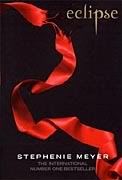 Eclipse Eclipse
by Stephenie Meyer
For the A-Z reading challenge.
English
628 pages
Atom Books
ISBN: 978-1-904233-90-9
First line: All our attempts at subterfuge had been in vain.
Back cover blurb:
As Seattle is ravaged by a string of mysterious killings and a malicious vampire continues her quest for revenge, Bella once again finds herself surrounded by danger. In the midst of it all, she is forced to choose between her love for Edward and her friendship with Jacob — knowing that her decision has the potential to ignite the ageless struggle between vampire and werewolf. With her graduation approaching, Bella has one more decision to make: life or death. But which is which?
Thoughts: It turns out that I’d somehow misunderstood that spoiler I read, because what I feared would happen, didn’t. At least not the way I thought it would, nor was it as bad as I thought it would be. In other words, I still like Jacob Black. Like him a lot, in fact. Even if I got really quite angry with him at one point, because dude! he needs to learn to listen to what people say!
I still don’t care much about either Bella or Edward. Bella, I’ve realised, reminds me a little of someone I used to know very well, with the exception that she (Bella, that is) can make decisions and stick with them, even if it’s hard.
I think this is my favourite of the series so far, even if some things made me exclaim “Ew! Ew! Ew!” whilst reading, and the divide between girlish and boyish interests/talents/&c still bothers me a lot.
A B rating is in order and I have to say I’m looking forward to the next book in this series, which is published sometime this summer, unless I am much mistaken.
|
|